Every other oracle asks you to trust the shuffle. Ziraja asks you to check the arithmetic.
A Sufi calculation that turns the wording of your question into a field of letters, with the answer already inside it. Guarded for centuries because the maths was brutal. Now it runs on your desktop in seconds.
The trouble with almost every system you have tried.
Shuffle the cards. Throw the coins. Cast the sticks, spill the tea, roll the bones. Whatever tradition you came up in, look closely at the moment the answer is decided and you will find a randomiser sitting in the middle of it.
That is the uncomfortable part nobody in the trade likes to say out loud.
The oracle is not the deck. The oracle is the shuffle.
Which leaves you with no way to check your work. Deal the same spread twice and you get two answers. Was the first one wrong, or was the second? There is nothing to appeal to.
And it leaves you exposed. Every skeptic you will ever argue with reaches for the same objection, and with a randomiser at the heart of the method, they are not entirely wrong to.
Ziraja is arithmetic. The input is not a random event. The input is your question, exactly as you word it.
Every letter carries a numerical value. Those values are worked through a fixed sequence of operations, and out the other side comes a grid of letters holding the answer.
Nothing in that chain is left to chance. Two people who put the identical question in get the identical grid out, in Manila or in Marrakesh, today or a year from now.
So when the letters spell a name, they did not fall that way. They were calculated that way.
A method with no randomiser can be tested. You can ask it something with a checkable answer, and see whether it was right.
Try that with a shuffled deck.
So why is almost nobody using it?
Because for most of its history you were not meant to. Ziraja belonged to the Sufi orders, passed from master to student, and the manuscripts that survive were not written to be understood by outsiders.
Then there is the labour. A single classical Ziraja means Arabic letter values, nested tables, a long chain of operations where one slip early on quietly poisons everything downstream.
An evening of careful work for one question, and no way to know whether you made an error until the answer comes out as nonsense. That is the real reason it stayed rare.
The software takes one Ziraja method and does that entire chain for you.
You do not need Arabic.
You do not need the tables.
You do not need to have sat with a shaykh.
You type your question in plain English and press the button.
An evening of calculations has become the press of a button.


Questions people have already put to it.
Start with the kind of question where you already know the answer. That is the honest way to test any oracle, and it is the fastest way to satisfy yourself that something real is happening.
Each of these was run through the software, and the letters were read out of the grid.

What country was bombed with nuclear bombs during a war before the year two thousand?

Who revealed the Thelemic book of the law?
Reassuring. And easy to wave away.
A skeptic can still say those answers were already known. Fair enough.
So the only test that really matters is one where the answer does not exist yet.
That is exactly what happened during the 2026 World Cup.
Live test: the 2026 World Cup.
On the thirteenth of July a customer bought the software, could not install it because he was out of the house, and asked me to run his question for him.
What followed was the cleanest test this method has ever had in public. Nobody knew the answers. They had not happened yet.
Every screenshot below is uncropped, and the timestamps are inside them.
These readings were made before the matches were played. They are published as a record of what was asked, what came back and what happened. They are not a promise about what your own question will do.
How the question got asked.
The purchase came through at 7:53 in the evening. Two minutes later he was asking how to work it, still out and stuck on his phone.
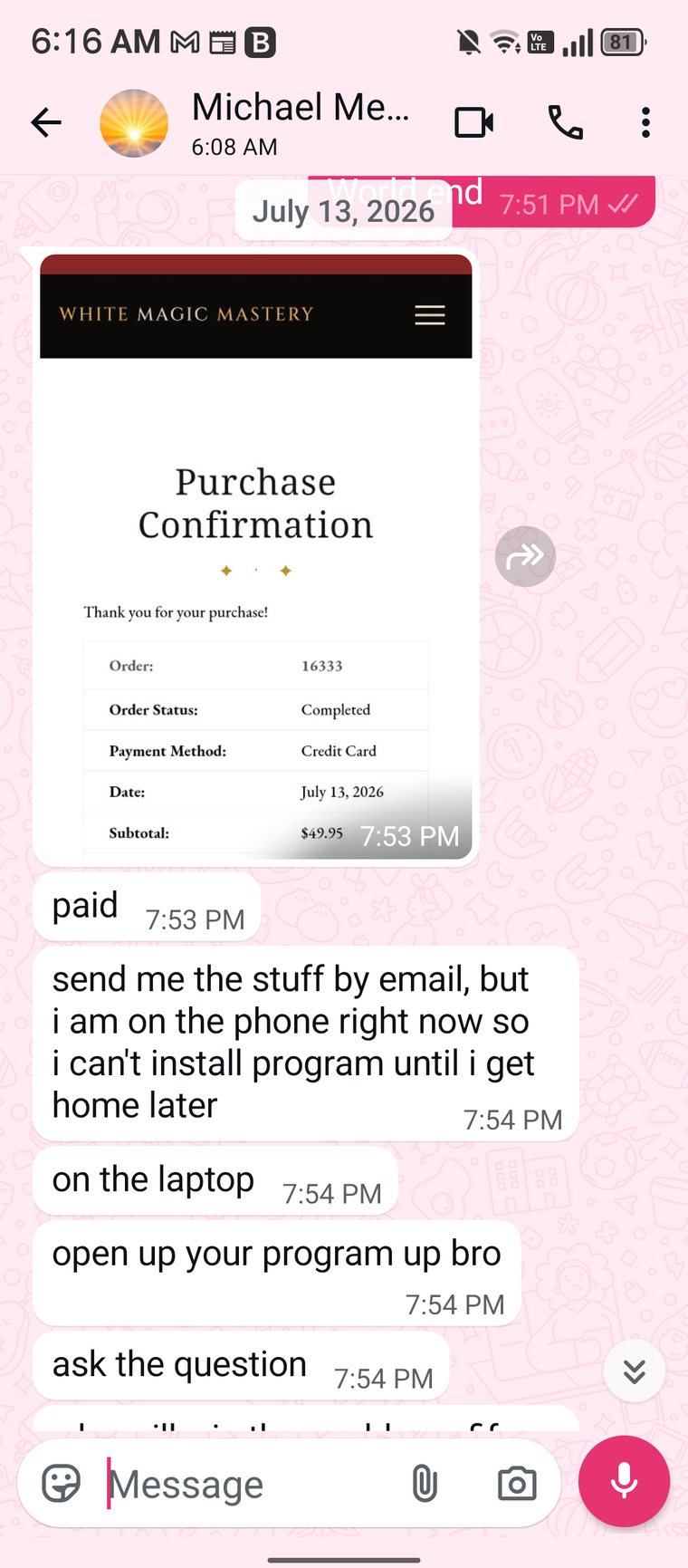
ChatGPT was used only to search the returned letters faster. Ziraja Software produced the field.
The first semifinal.
This is the output exactly as Ziraja produced it. Each block gives a line of raw letters, then the family alternatives available at every position in that line.
R (E,N) (E,N) (D,V) R (N,W) (N,W) (E,N) R
Y L M V V N U F A
(G,P) (C,U) (D,V) (D,M) (D,M) (E,W) (C,L) (O,X) (J,S)
S F E
(A,J) (O,X) (N,W)
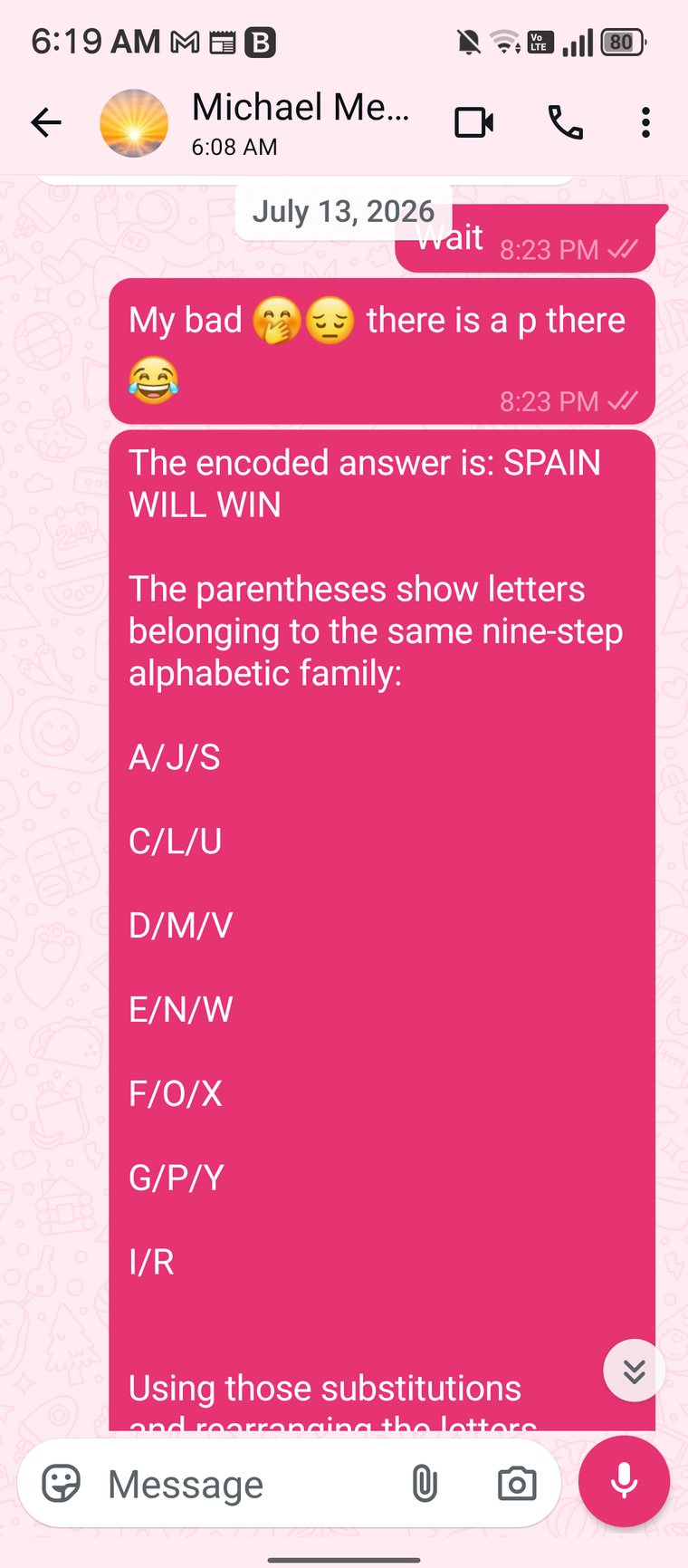
The second block is where the reading locks. From the available families, SPAIN can be formed cleanly as the winning country.
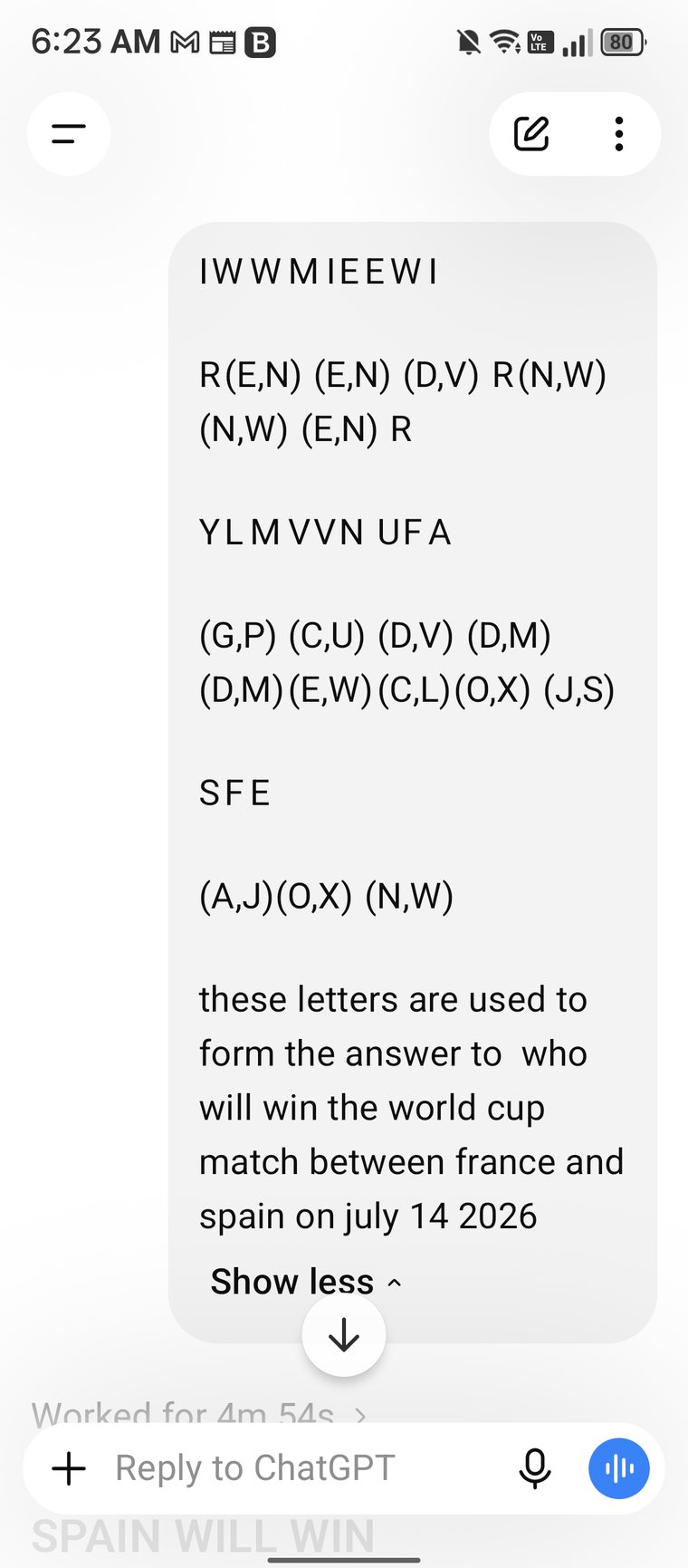
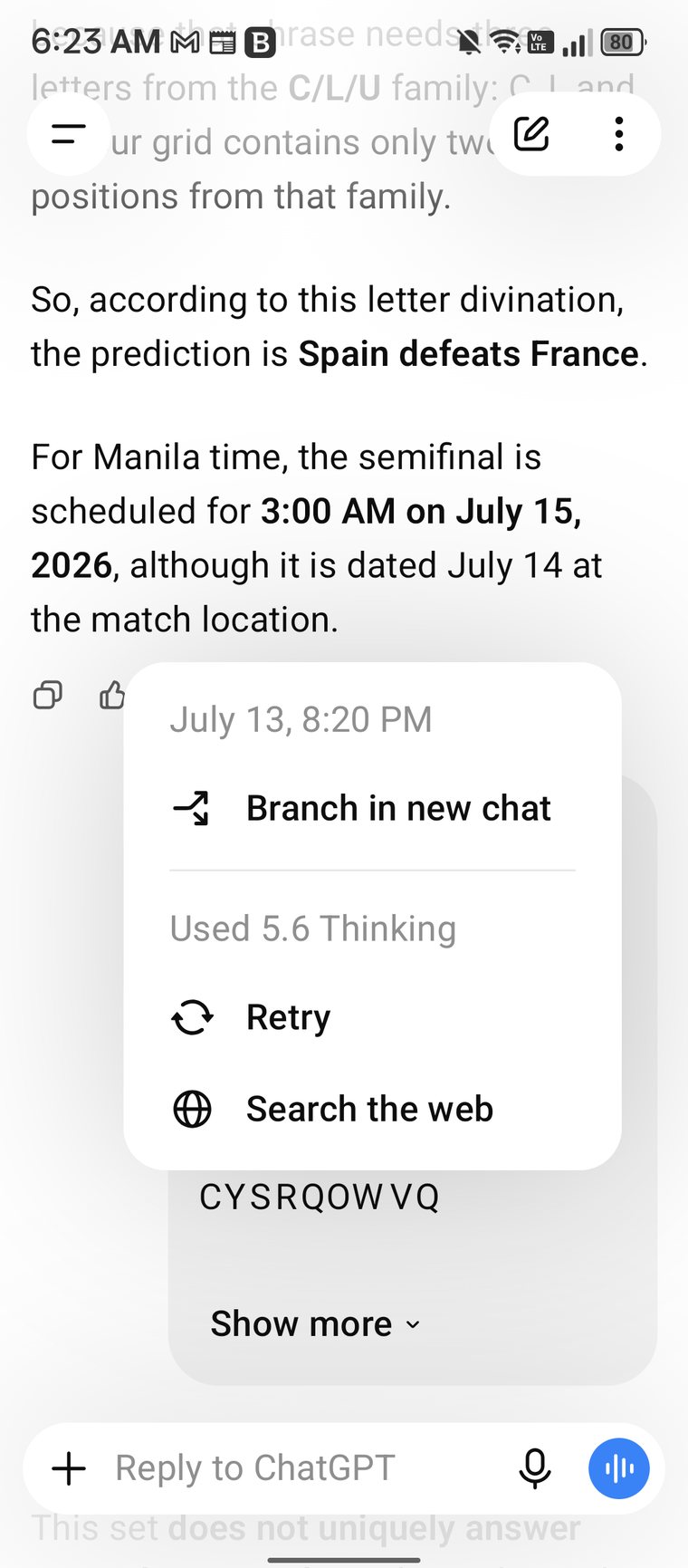
Spain beat France 2–0 the following afternoon. The Ziraja reading naming Spain had been sent before kickoff.
The second semifinal.
Two days later, a second match and a second grid. This time the reading turned on what the letters could not do.
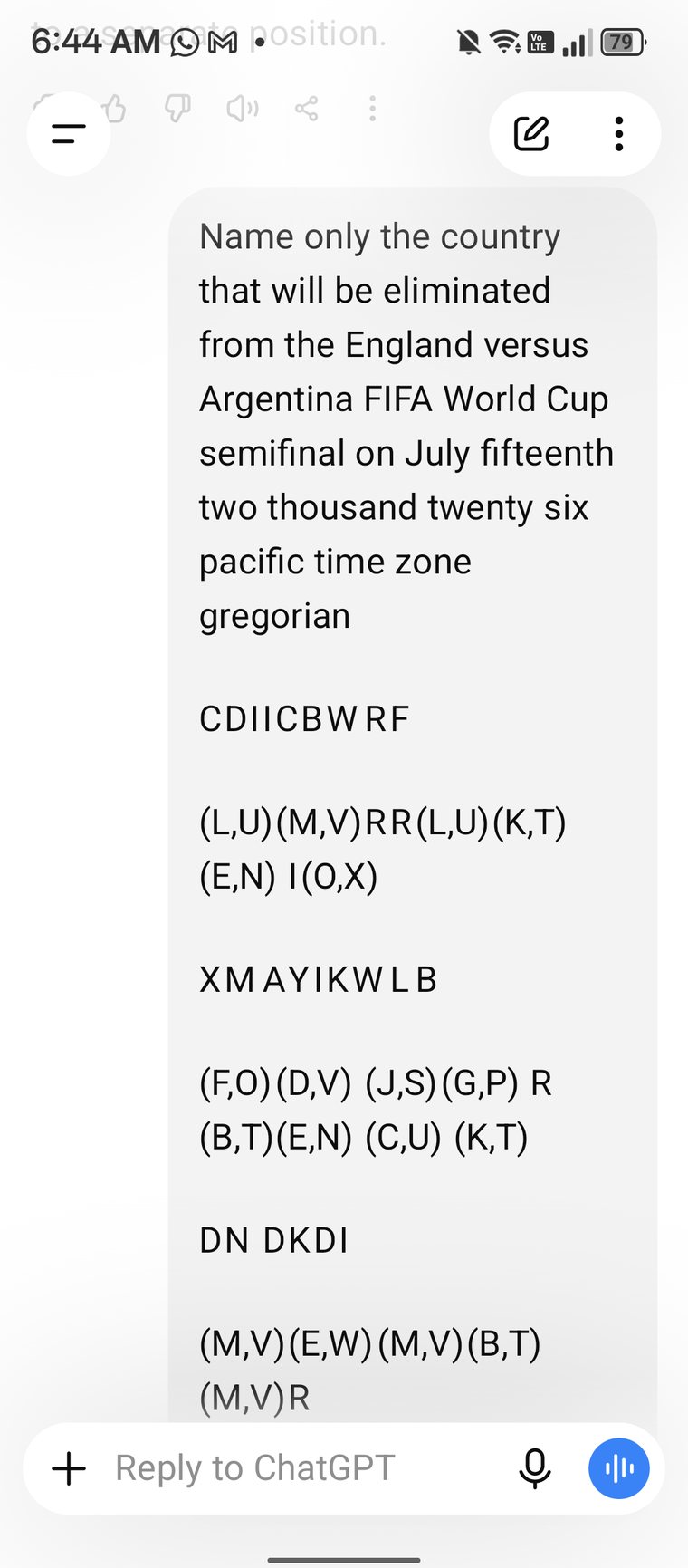
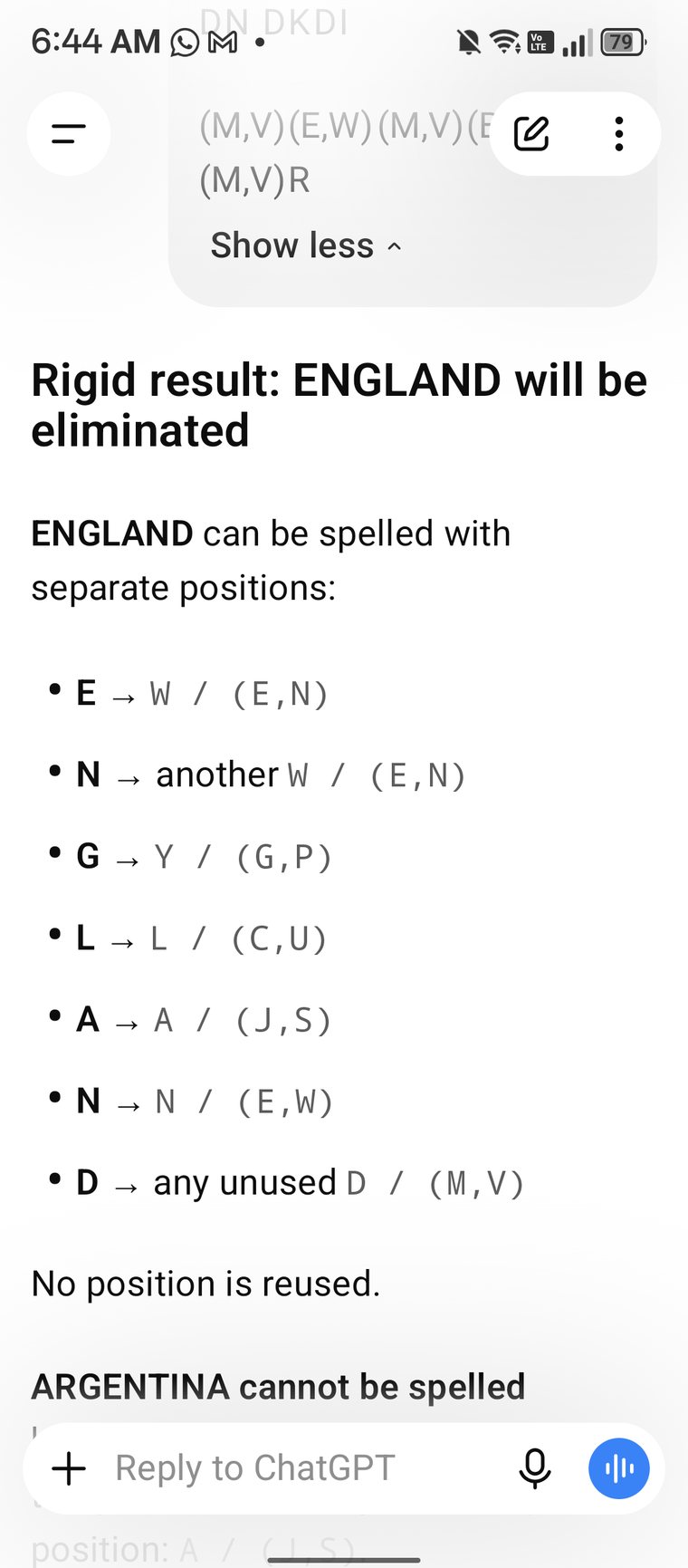
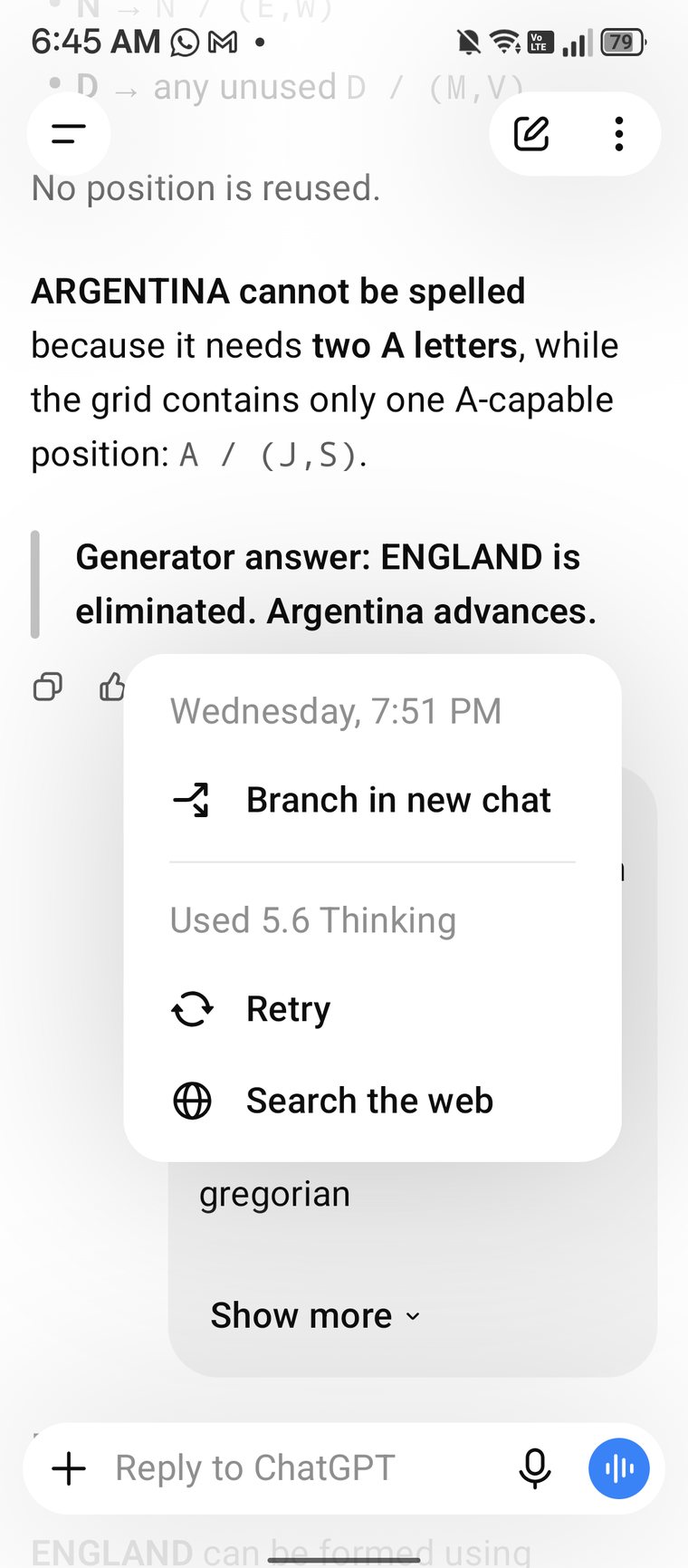
Because the question asked which country would be eliminated, the clean formation of ENGLAND supplied the answer.
Argentina beat England 2–1, eliminating England exactly as the reading sent before kickoff had stated.
The third place match.
Five days later he came back with the next fixture.
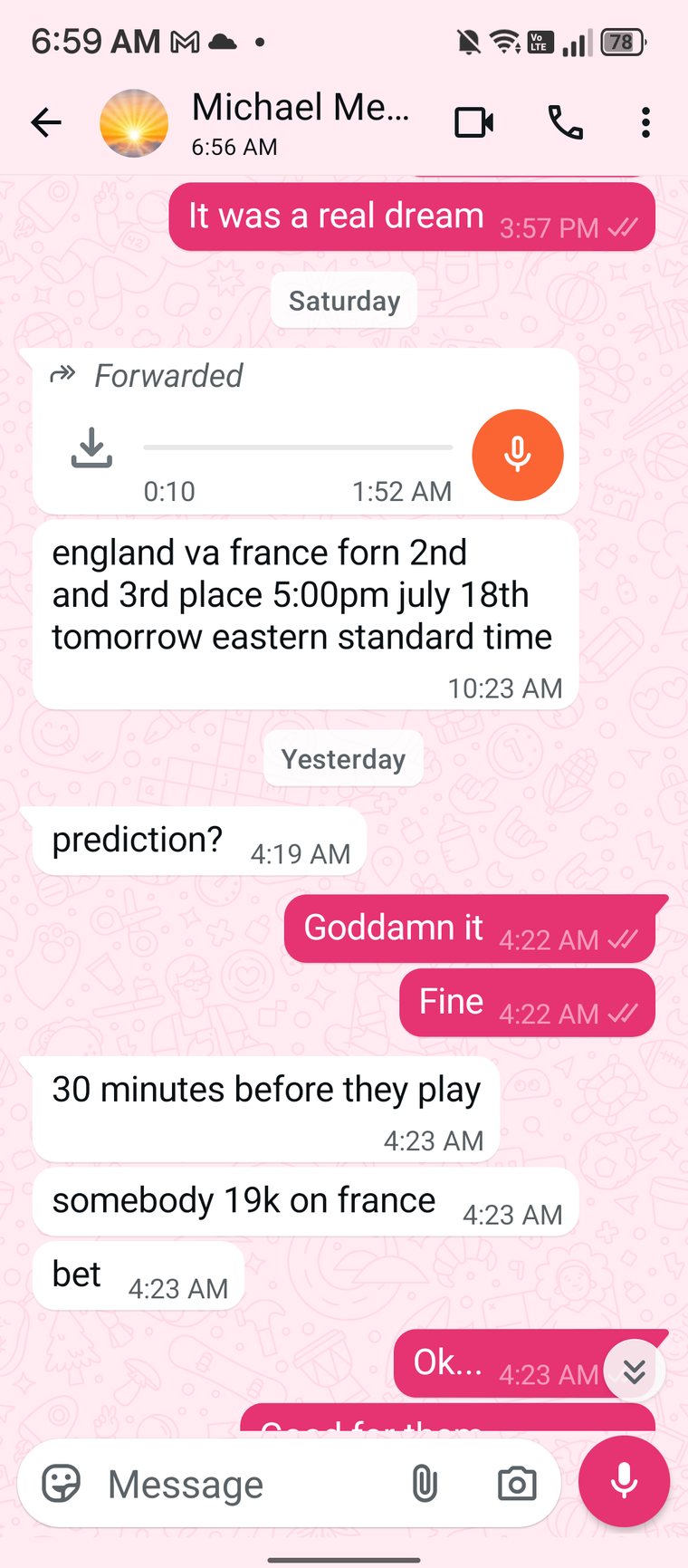
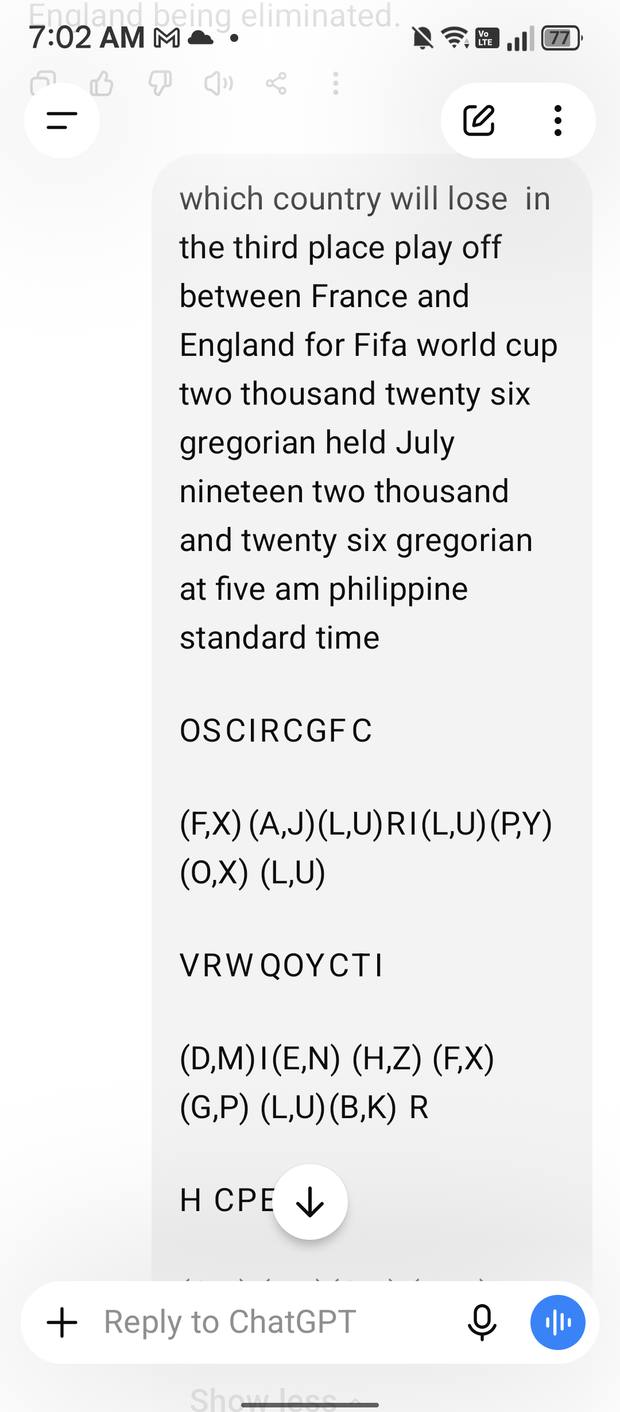
This time the question went in three separate ways, worded differently each time, to see whether the grids would agree with each other.
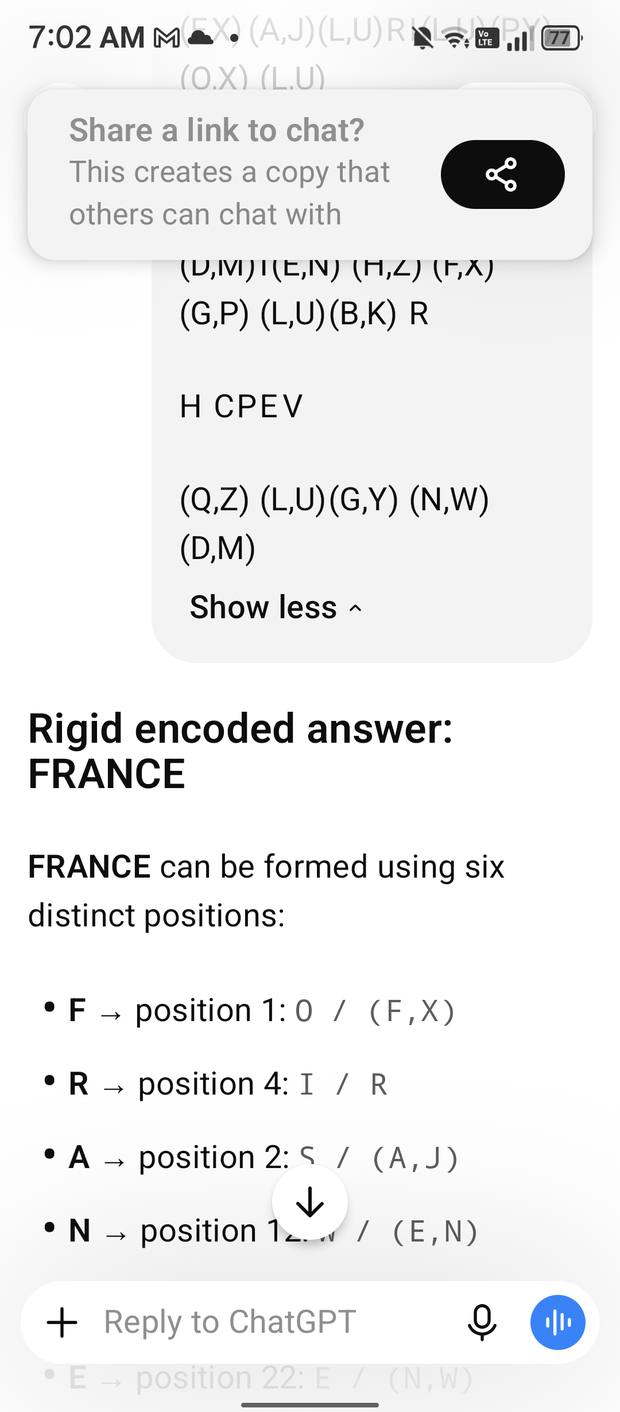
Question one: who loses
The plainest framing. The grid resolved with no letter reused.
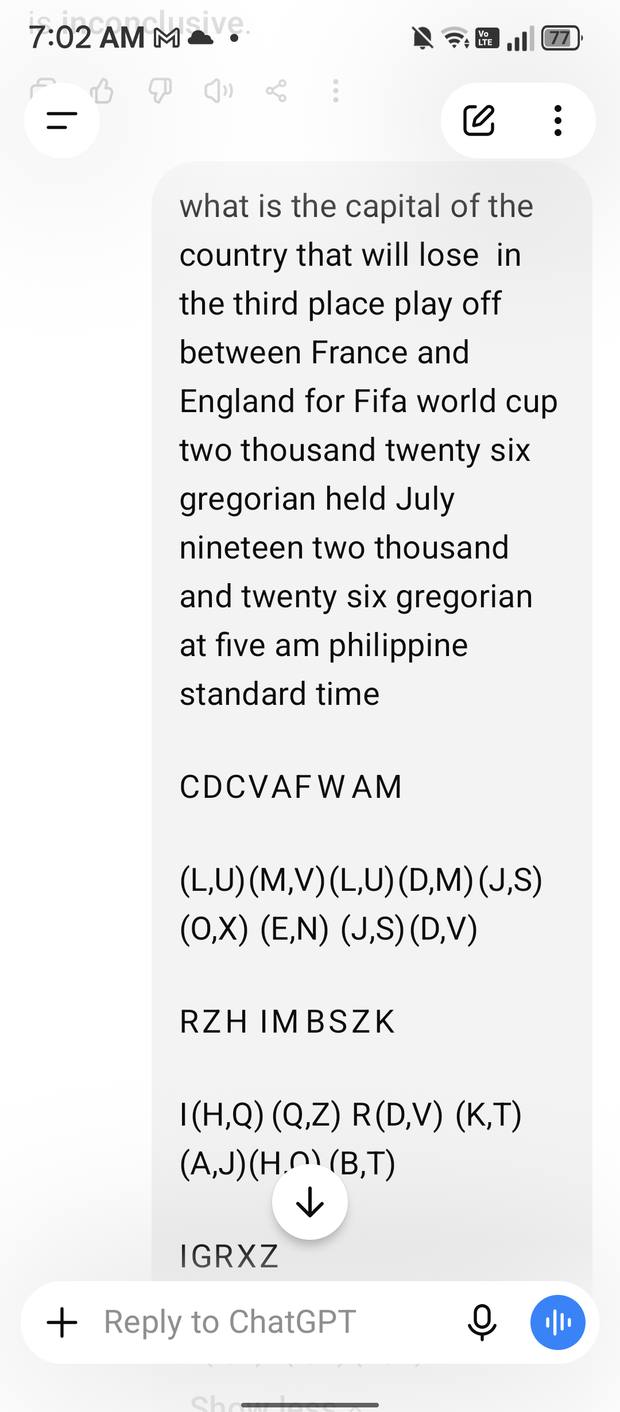
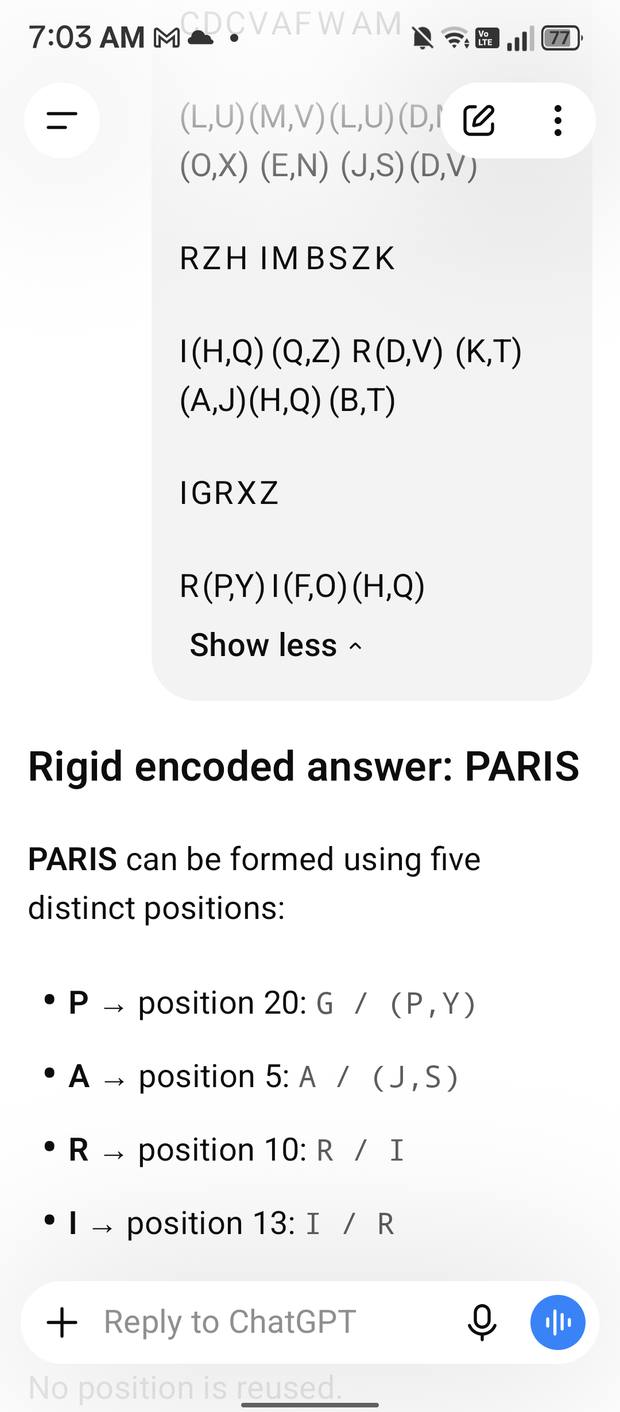
Question two: the capital of the loser
Asking for a city instead of a country changes the letters required. PARIS came out clean, and LONDON could not be built from that same grid at all.
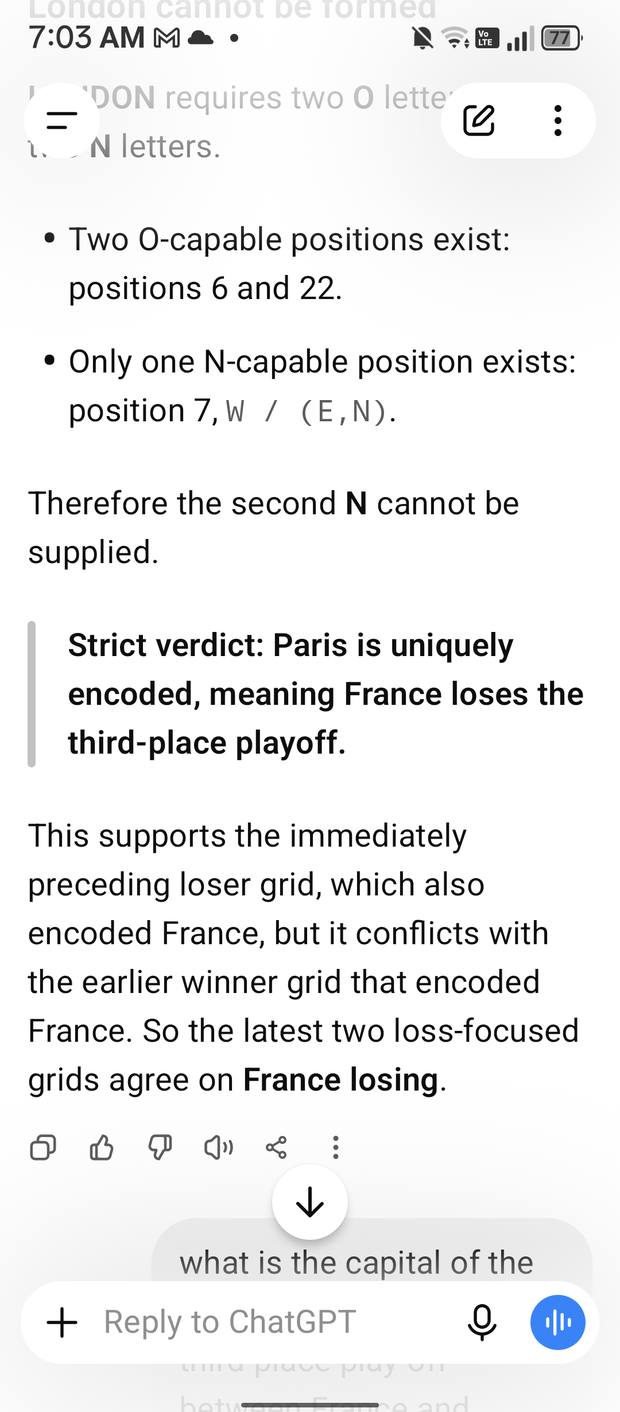
Question three: the capital of the winner
Asked directly. What is the capital of the country that will be victorious in the third place play off. It answered London.
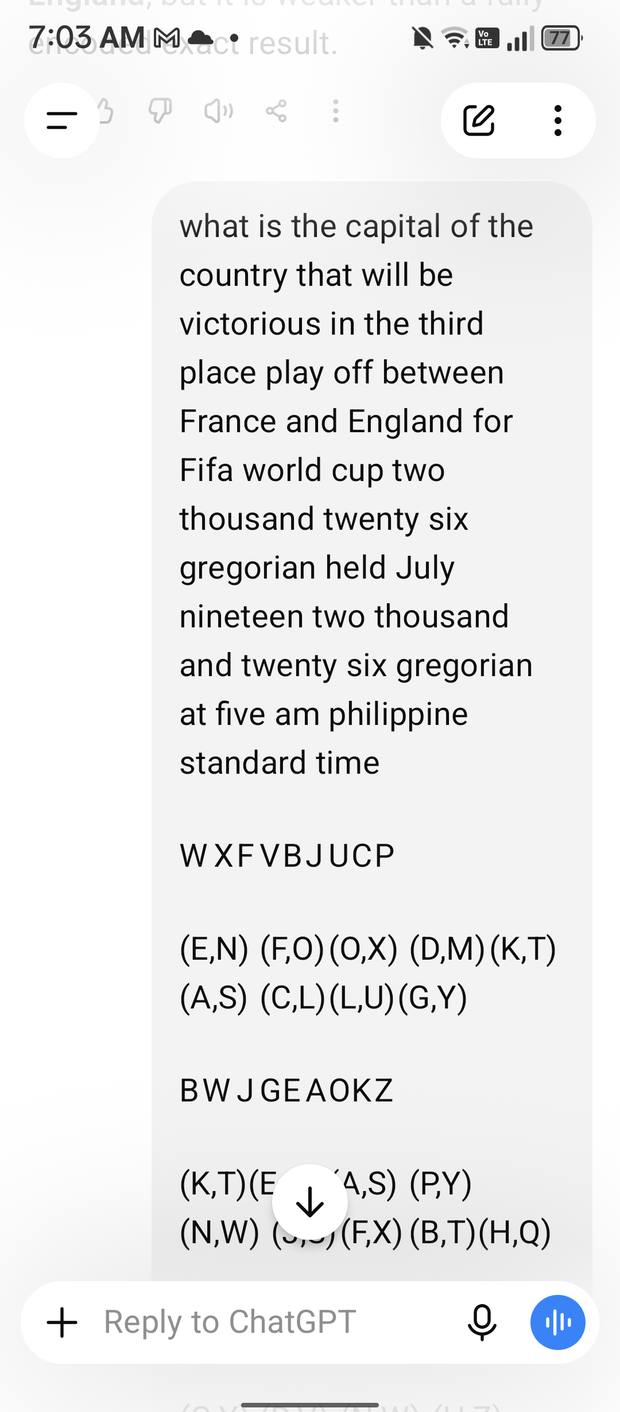
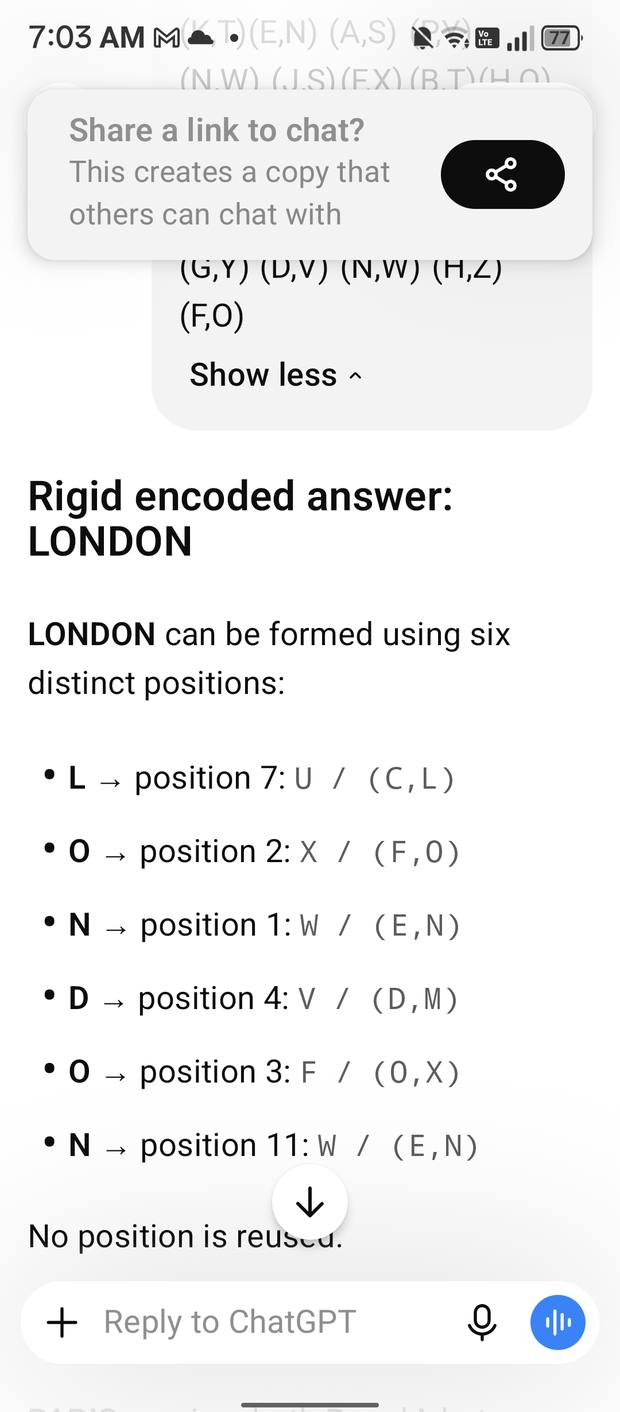
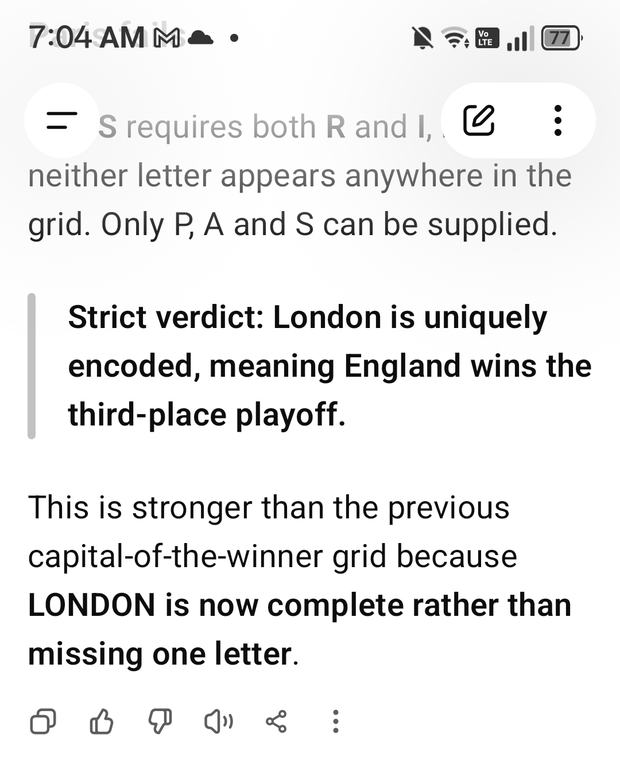
England won 6–4. All three readings—France, Paris and London—had pointed to that result before kickoff.
Three questions, three different wordings, one country.
The final.
By now he was running his own comparison. A shaman in Peru had told him Argentina. The software had said Spain.
So the final went in twice, worded two different ways, before a ball was kicked.
Question one: who wins the final
Argentina could not be built. The name needs one E and two N, which means three positions capable of E or N, and the grid held only two.
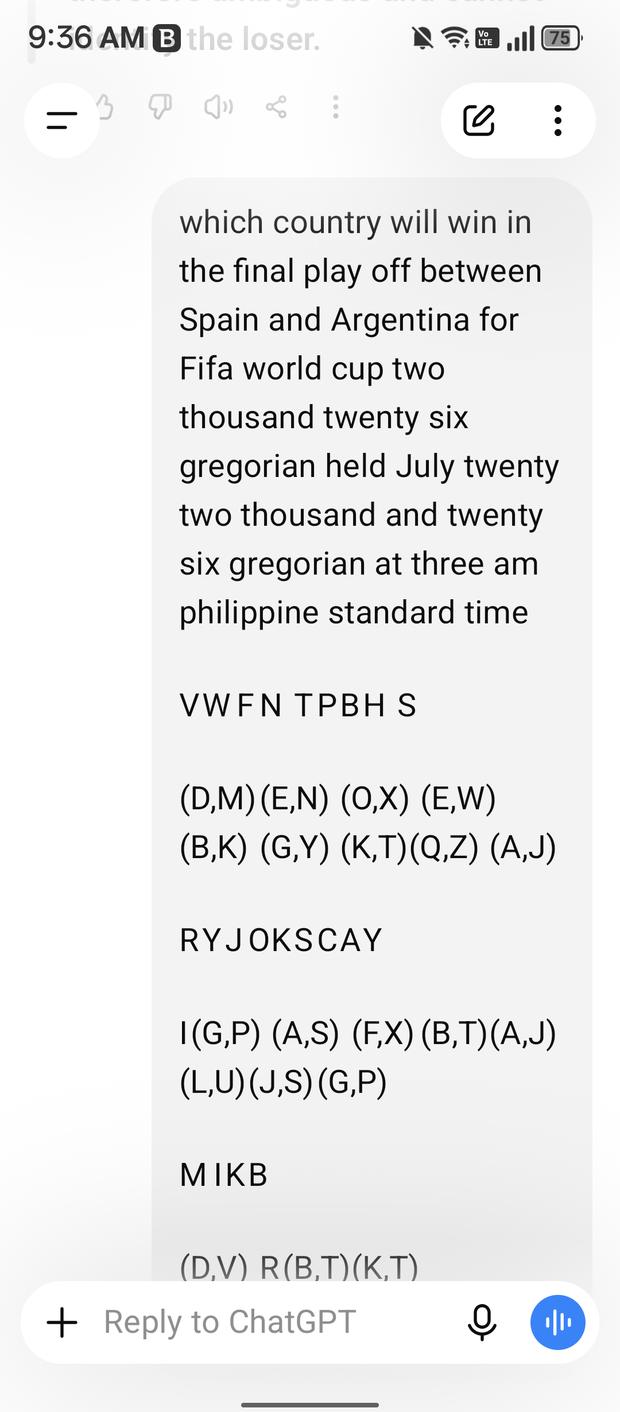
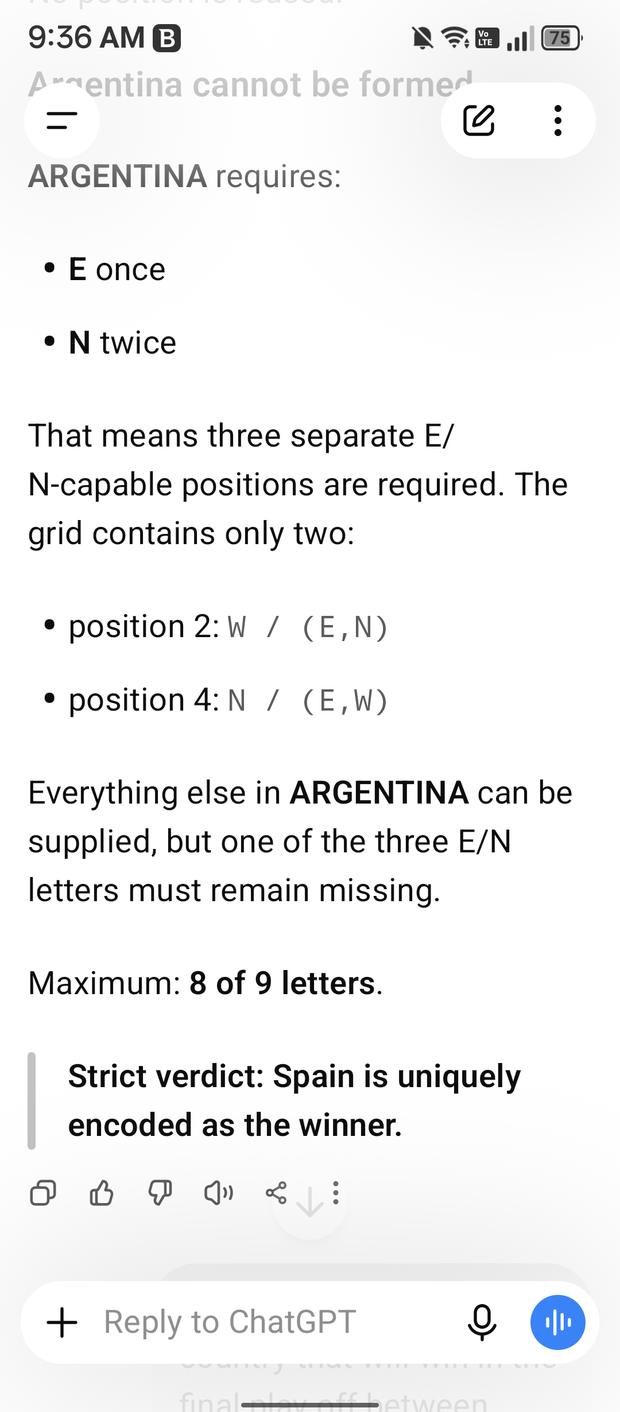
Question two: who is crowned champion
The same match asked again in completely different words. It answered Spain again.
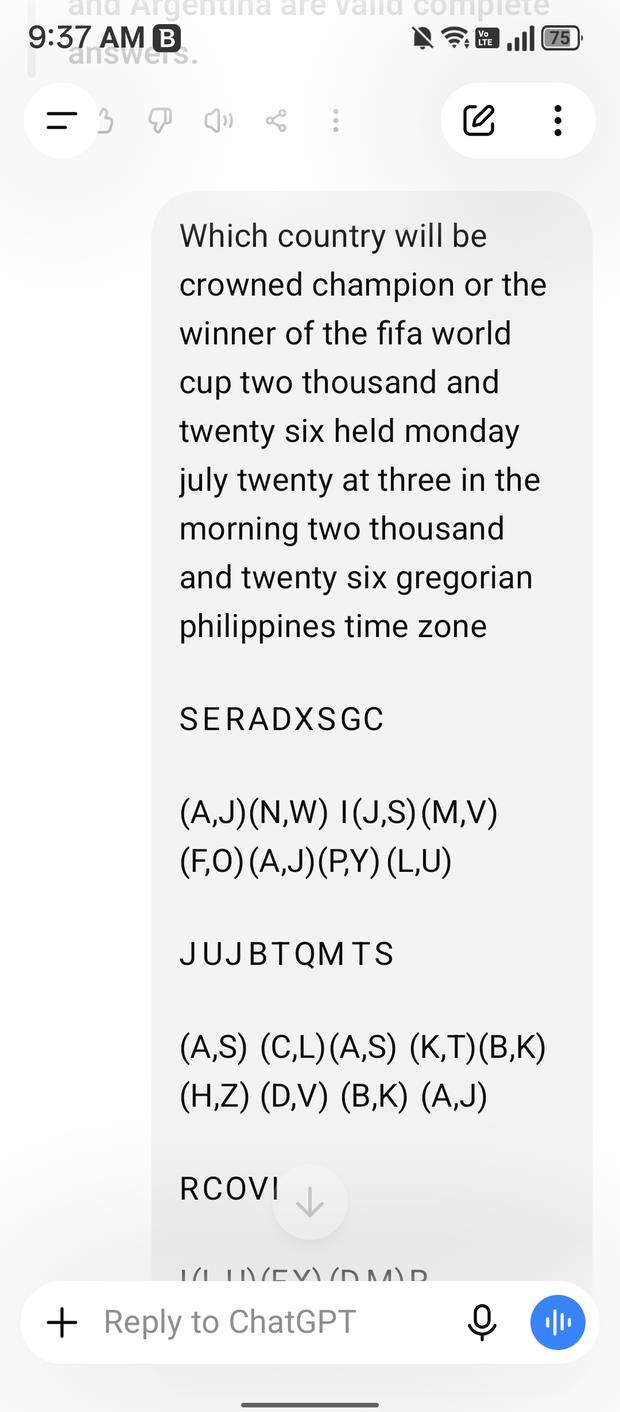
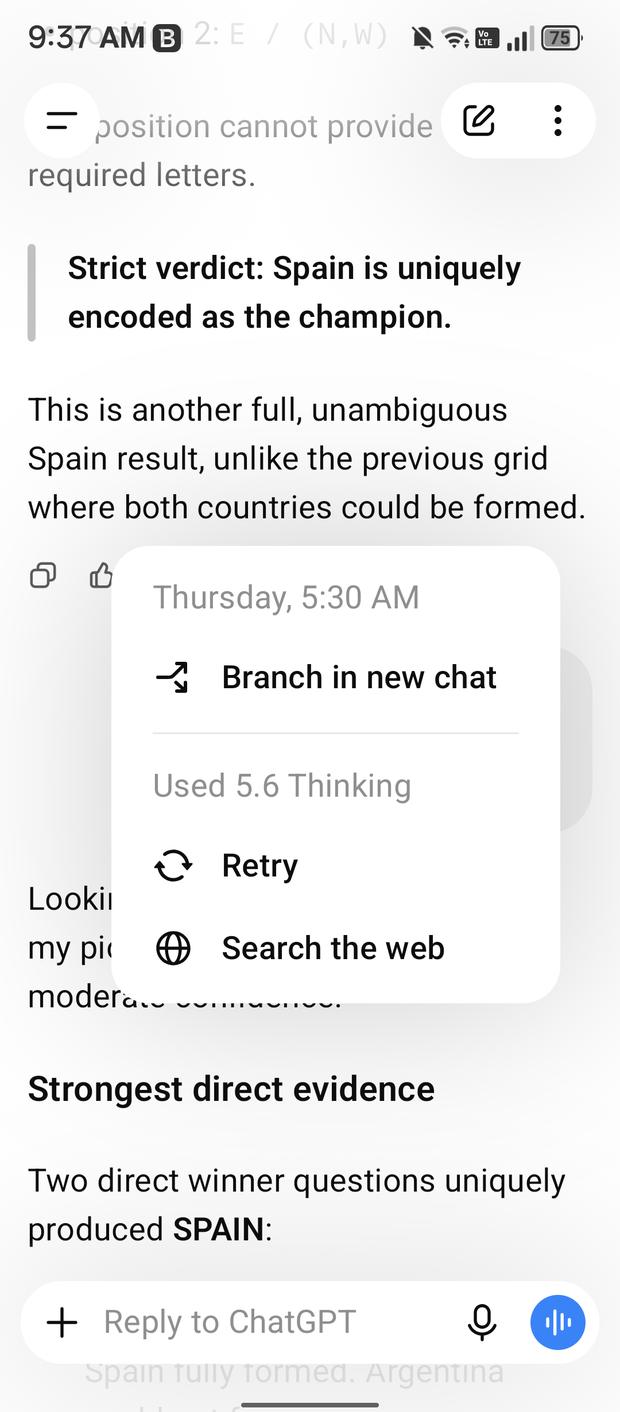
The exchange below happened while the match was still level, with the call already on record.
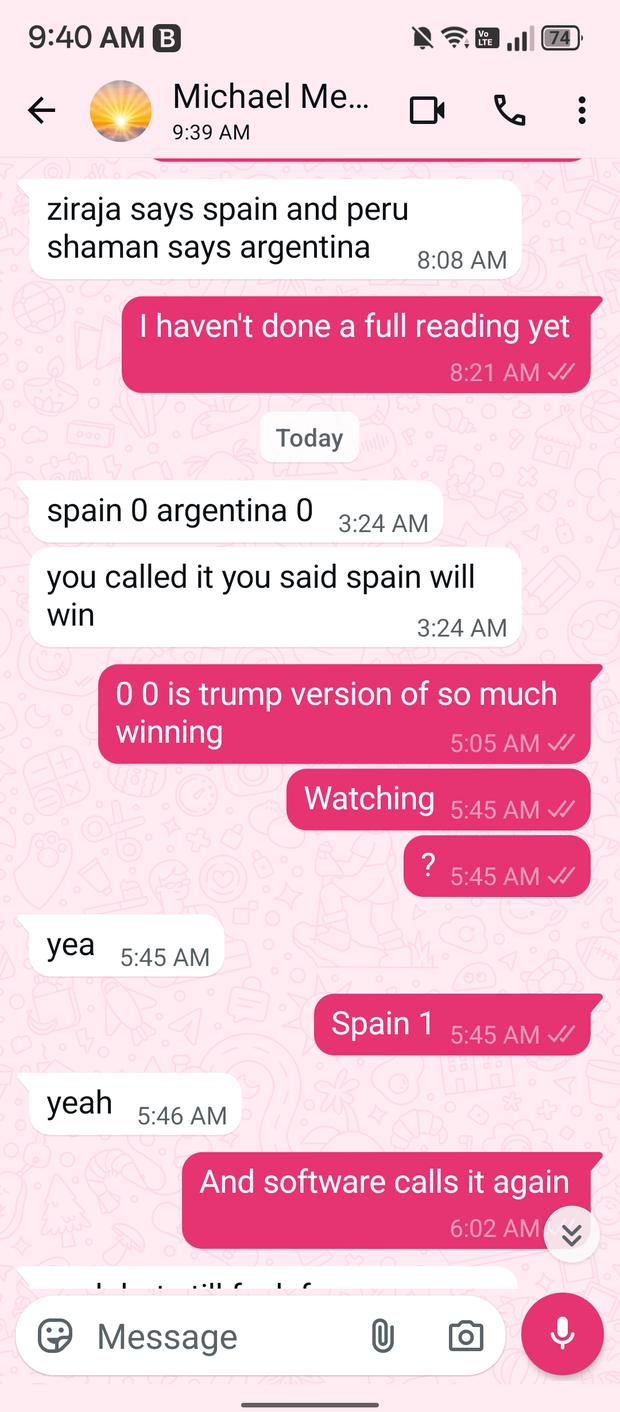
Spain won 1–0 after extra time, with Ferran Torres scoring in the 106th minute. Both Ziraja readings naming Spain had been sent before kickoff.
The whole run, in order.
How it actually works.
Here is the honest mechanic, because you should know what you are buying before you buy it.
You enter the question
Plain English, worded precisely. Names, dates, places, times. The wording is the input, so spell it the way you mean it.
The software builds the grid
It runs the classical Ziraja calculation and returns your field of letters, along with the family alternatives available at each position. This is the part that used to take an evening.
You Read What Fits
Once the field appears, you look for the name, place, phrase, or short answer that fits the question. You are not solving a random anagram. The question has already told you what kind of answer to look for.
Some answers appear immediately. Others take patience. You can work by eye or use ChatGPT as a convenience.
For convenience, we pasted the letter fields into ChatGPT while documenting the World Cup test. It helped us search the available letters faster, but it did not produce the Ziraja calculation and it is not required to use the software.
Ziraja Software produced every field shown above. You can examine the letters yourself or use whatever aid you prefer.
Ask the same matter from another precise angle. When the same answer returns through a different question, your confidence rises.
That is exactly what happened during the World Cup test: France, Paris and London all pointed to the same result, while both questions about the final returned Spain.
Put your own question to it.
Ziraja does not care about form tables, betting markets or who the pundits fancy. It takes a properly framed question and returns letters.
Frame the question. Run the calculation. Read what fits.
- Full Ziraja Software for Windows, yours to keep
- Unlimited questions with no per-reading charge
- Quick-start instruction manual
- Plain-English questions with no Arabic or tables required
- Immediate delivery by email
Save $49.95 - Use Code: ZirajaFifa at Checkout
Day(s)
Hour(s)
Minute(s)
Second(s)
Windows PC required. Quick digital delivery.